
Failed Root Canal Symptoms: When Do You Need an RCT Re-Treatment in Jaipur?
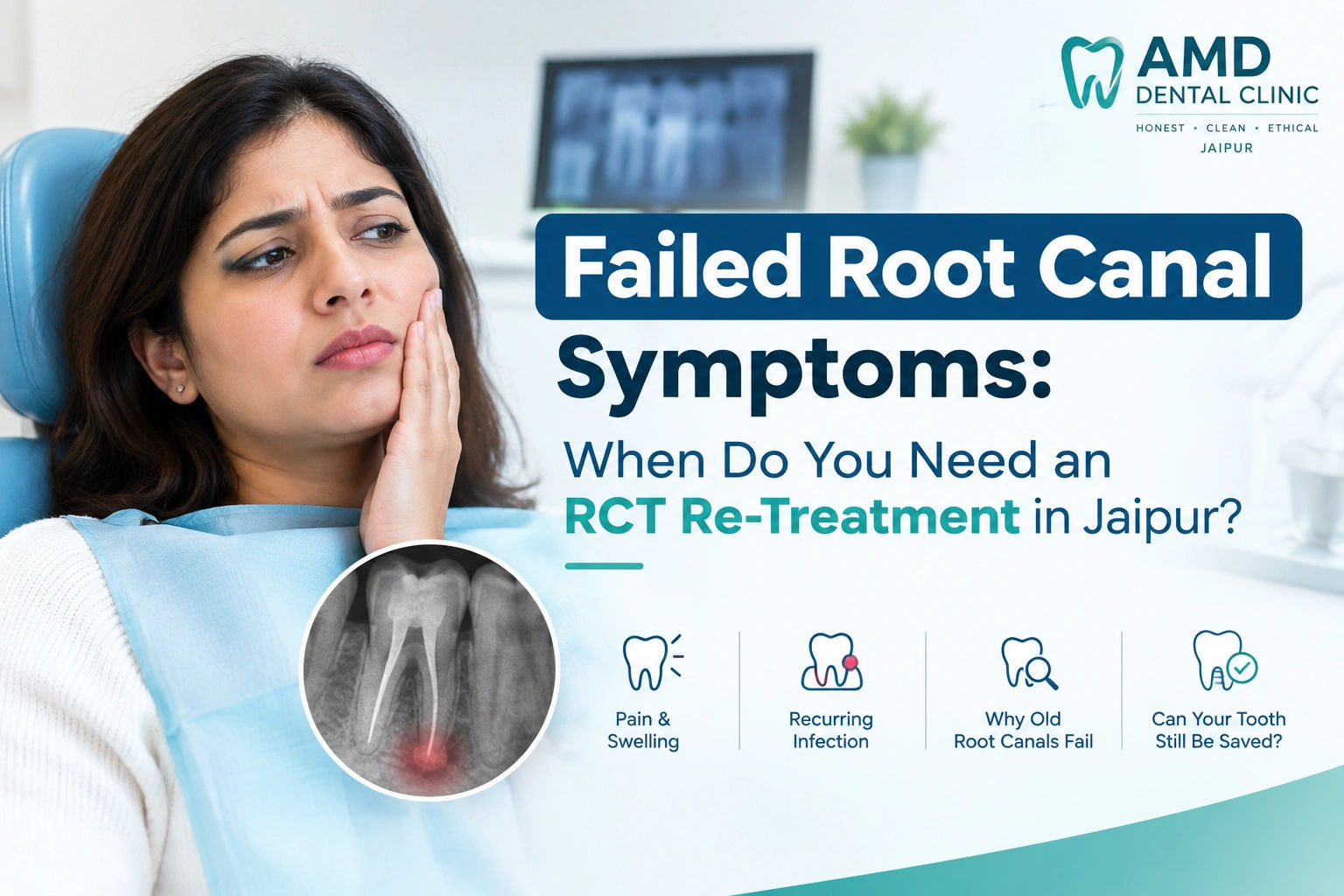
A root canal treatment (RCT) is designed to save a natural tooth that has an infected or damaged pulp. When properly diagnosed, cleaned, disinfected, sealed, and restored with a good-quality crown, a root canal-treated tooth can function successfully for many years.
But what happens when a tooth that already had an RCT starts hurting again?
Pain, swelling, a recurring gum boil, tenderness while chewing, or a persistent infection around the root may indicate that the previous root canal has not healed as expected. However, pain after an old RCT does not automatically mean the tooth needs extraction.
In many cases, the natural tooth can still be saved with root canal retreatment (re-RCT).
At AMD Dental Clinic, Jaipur, we believe that extraction should not be recommended simply because a tooth has had a previous root canal. The first step is to understand why the treatment failed and whether the tooth has a reasonable prognosis.
What Is Root Canal Retreatment?
Root canal retreatment, commonly called re-RCT, is a procedure performed on a tooth that has already undergone root canal treatment but has developed persistent or recurrent infection or other complications.
During the original RCT, infected pulp tissue and bacteria are removed from the root canal system. The canals are then cleaned, shaped, disinfected and sealed.
If bacteria remain inside the tooth, or if the tooth becomes contaminated again later, infection can persist or return.
Retreatment involves reopening the previously treated tooth, removing the old root filling material where possible, carefully locating and disinfecting the canal system, identifying the reason for failure, and sealing the canals again.
The important point is this:
A failed RCT is not necessarily a failed tooth.
Whether the tooth can be saved depends on factors such as remaining tooth structure, periodontal support, presence of a fracture, quality of the previous treatment and the cause of infection.
What Are the Common Symptoms of a Failed Root Canal?
Not every root canal-treated tooth that feels uncomfortable has failed. Some teeth can remain mildly sensitive for a short period after treatment, particularly when there was significant infection before the procedure.
However, certain symptoms should prompt an evaluation.
1. Pain while chewing or biting
If a tooth that had an RCT becomes painful when you bite on it, especially months or years after treatment, it deserves investigation.
The cause may be persistent infection, an excessively high crown, a crack or other problems around the tooth.
2. Recurring swelling or a gum boil
A small pimple-like swelling on the gum near a previously root canal-treated tooth can sometimes indicate a draining sinus tract caused by infection around the root.
It may disappear temporarily, but the underlying infection can still remain.
3. Persistent or recurrent infection
An infection around the root may sometimes be visible on an X-ray or CBCT even when the patient has little or no pain.
This is one reason why symptoms alone cannot determine whether an RCT has failed.
4. Sensitivity or discomfort that returns after years
A tooth that was comfortable for several years and then develops pain or swelling may have developed a new problem.
Possible causes include leakage through an old crown or filling, recurrent decay, a new infection or structural damage.
5. A poorly done previous root canal
Sometimes the problem is visible on the dental X-ray itself.
Examples include:
Missed canals
Inadequate cleaning or shaping
Short or poorly condensed root filling
Voids in the root filling
Untreated anatomy
Instrument separation
Persistent infection
Poor coronal seal
A detailed assessment is required before deciding whether retreatment can predictably help.
Why Do Root Canals Fail?
Root canal treatment is performed inside a highly complex three-dimensional canal system. Teeth do not always have simple, straight canals.
One of the most common reasons for persistent infection is untreated or missed canal anatomy.
Missed canals
Some teeth have additional canals that can be difficult to identify.
For example, upper first molars frequently have a second mesiobuccal canal, commonly known as MB2. If an infected canal remains untreated, bacteria can continue to survive inside the tooth.
Other teeth can also have anatomical variations, curvatures, accessory canals and complex canal systems.
This is why retreatment should not simply mean “doing the same RCT again.”
The dentist must first determine why the previous treatment failed.
Leaking crowns and fillings
Even a technically good RCT can be compromised if the tooth is not adequately sealed afterward.
A defective crown, leaking restoration, recurrent decay or fracture can allow bacteria to enter the previously disinfected root canal system.
This is called coronal leakage or reinfection.
That is why the final restoration of a root canal-treated tooth is not merely cosmetic. It is an important part of protecting the tooth from future contamination.
Inadequate cleaning and disinfection
Root canals contain microscopic irregularities and complex anatomy.
If infected tissue and bacteria are not adequately removed, infection can persist.
A retreatment procedure therefore requires careful mechanical cleaning combined with appropriate irrigation and disinfection.
Tooth fracture
Not every painful root canal-treated tooth needs another RCT.
A crack or vertical root fracture can significantly change the prognosis.
If a tooth has a significant vertical root fracture, retreatment may not be the appropriate solution and extraction may ultimately be required.
This is why diagnosis comes before treatment.
At AMD Dental Clinic, we prefer to establish the cause of symptoms before recommending a procedure.
How Is RCT Retreatment Different From the First RCT?
A re-RCT can be considerably more challenging than an initial root canal.
The tooth has already been treated, and the dentist may need to work through an existing restoration, remove old root filling material, identify previously missed anatomy and manage complications.
A specialist assessment may involve:
Clinical examination
The tooth, surrounding gums, bite and periodontal condition are examined carefully.
Dental X-rays
Radiographs help evaluate the previous root canal filling, root anatomy and any changes around the root.
CBCT when required
A CBCT scan can provide three-dimensional information that may not be visible on conventional two-dimensional X-rays.
It can be particularly useful when the diagnosis is uncertain or when the dentist needs to assess:
Missed canals
Extent of periapical lesions
Root anatomy
Possible perforation
Suspected fracture
Relationship with surrounding structures
CBCT should not necessarily be taken for every root canal case. It should be prescribed when the additional information can influence diagnosis or treatment planning.
Can a Tooth Recommended for Extraction Be Saved?
Sometimes, yes.
Patients occasionally come to AMD Dental Clinic after being told that a previously root canal-treated tooth needs extraction.
An extraction recommendation may be appropriate in some cases—for example, when there is an unrestorable tooth, severe structural destruction, a confirmed vertical root fracture, or inadequate periodontal support.
But previously failed RCT alone is not a reason to automatically remove a tooth.
If the tooth has sufficient remaining structure and there is a treatable endodontic cause, retreatment may provide an opportunity to preserve the natural tooth.
This is particularly important because preserving a natural tooth, when predictably possible, can sometimes be preferable to immediately moving toward extraction and replacement with an implant or bridge.
At AMD Dental Clinic, our approach is simple:
First determine whether the tooth can be predictably saved. Then discuss all appropriate options with the patient.
What Happens During an RCT Re-Treatment at AMD Dental Clinic?
At AMD Dental Clinic in Jaipur, treatment planning begins with diagnosis rather than immediately starting the procedure.
The typical process may include:
1. Review of your previous RCT
We assess existing X-rays, restorations and treatment history wherever available.
2. Clinical examination
The tooth, gums, bite and surrounding tissues are examined.
3. Imaging
A dental X-ray is taken, and CBCT may be advised when clinically necessary.
4. Identify the reason for failure
The aim is to determine whether the problem is related to missed anatomy, inadequate previous treatment, leakage, recurrent decay, fracture or another cause.
5. Retreatment
Where the tooth is considered suitable, the previous root filling material is carefully managed and the canal system is cleaned, disinfected and appropriately sealed.
6. Final restoration
Once endodontic treatment is completed, the tooth needs an appropriate restoration to protect it from leakage and fracture.
The exact treatment sequence varies from patient to patient because every failed RCT has a different cause.
Root Canal Retreatment Cost in Jaipur
One of the most common questions patients ask is:
“What is the root canal retreatment cost in Jaipur?”
There is no single price that applies to every re-RCT.
The cost can vary depending on:
Which tooth is involved
Number and complexity of canals
Difficulty in removing previous root filling material
Presence of posts or existing restorations
Need for CBCT
Complexity of the infection
Whether additional procedures are required
Type of final restoration required
A straightforward retreatment and a technically complicated retreatment are not equivalent procedures.
At AMD Dental Clinic, we prefer to examine the tooth first and explain the treatment plan and expected costs before proceeding.
If you are comparing the cost of root canal retreatment in Jaipur, it is worth asking what is included in the quoted fee rather than comparing only the headline price.
When Is Extraction Actually Necessary?
Although saving the natural tooth is desirable when possible, retreatment is not always the right answer.
Extraction may be considered when:
The tooth has a confirmed vertical root fracture
Very little healthy tooth structure remains
The tooth cannot be adequately restored
There is severe periodontal destruction
The root or tooth has structural damage that cannot be predictably managed
Previous treatment has failed and no predictable retreatment option exists
A responsible dentist should explain both the tooth-saving option and the reasons extraction may be necessary when applicable.
The goal should not be to save every tooth at any cost. The goal is to make the most predictable decision for the patient.
Why Choose AMD Dental Clinic for Root Canal Retreatment in Jaipur?
When a previously treated tooth starts causing problems, experience and diagnosis matter.
At AMD Dental Clinic, Jaipur, we focus on evidence-based and ethical dental care rather than recommending procedures simply because they are possible.
Our approach includes:
MDS-led dental care
Detailed diagnosis before treatment
Appropriate use of dental imaging and CBCT
Focus on preserving natural teeth whenever predictably possible
Modern endodontic techniques and technology
Transparent discussion of treatment alternatives
No unnecessary procedures
A patient-first approach
AMD Dental Clinic has also treated a large number of root canal cases, with 20,000+ RCTs performed as part of our clinical experience.
For patients searching online for the best dentist in Jaipur or the best dental clinic in Jaipur, we believe the more important question is not simply which clinic has the strongest marketing.
Ask:
Who will diagnose my problem properly?
Who will explain why my previous RCT failed?
Can my natural tooth still be saved?
And what is the most predictable treatment for my particular tooth?
These questions can help you make a much better decision.
Don't Assume That a Failed RCT Means Extraction
If a root canal-treated tooth has started hurting again, swelling has appeared, or an X-ray shows a persistent infection, don't panic.
A failed root canal can have several causes, and some of them can be treated successfully with retreatment.
At the same time, not every painful RCT should automatically be re-treated. A proper clinical examination, appropriate imaging and assessment of the tooth's restorability are essential.
If you have been advised to extract a previously root canal-treated tooth in Jaipur, consider getting a specialist second opinion before making an irreversible decision.
At AMD Dental Clinic, our philosophy is straightforward:
Save the natural tooth when it can be saved predictably. Extract it when saving it is no longer a reasonable option.
If you are experiencing RCT failure symptoms and want to know whether your tooth needs root canal retreatment in Jaipur, you can consult the team at AMD Dental Clinic, Jaipur for a detailed evaluation and personalized treatment plan.
Frequently Asked Questions
How do I know if my root canal has failed?
Pain while biting, recurrent swelling, a gum boil, persistent infection around the root, or a poorly treated root canal can indicate a problem. However, some failed RCTs may have no symptoms and are discovered on X-rays.
Can a failed root canal be treated again?
Yes. Many previously treated teeth can undergo root canal retreatment if the tooth is structurally sound and the cause of failure can be addressed.
Is re-RCT better than extraction?
If the natural tooth can be predictably saved, preserving it may be a valuable option. However, extraction can be the better choice when the tooth is fractured, unrestorable or has a hopeless prognosis.
Is CBCT necessary for RCT retreatment?
Not always. CBCT is generally considered when three-dimensional information is needed to clarify diagnosis or treatment planning.
What is the root canal retreatment cost in Jaipur?
The cost depends on the tooth, complexity, previous treatment, number of canals, restorations and any additional procedures required. An examination is needed for an accurate estimate.
Can a tooth with a large infection still be saved?
Sometimes, yes. The size of a periapical lesion alone does not necessarily mean that the tooth must be extracted. The overall condition of the tooth and the cause of infection are important in determining prognosis.
Need a Second Opinion for a Failed Root Canal?
If you have been told that your root canal-treated tooth cannot be saved, don't make the decision based on the X-ray alone.
Get the tooth properly evaluated.
AMD Dental Clinic, Jaipur
MDS-led dental care | Root Canal Treatment | RCT Retreatment | Dental Implants
Your natural tooth deserves a proper diagnosis before it is removed.
- A-3, Natraj Nagar near Imli Phatak, Jaipur-302015
- +91 9945826926
- contact@amddentalclinic.com

Are Electric Toothbrushes Good for Your Teeth? | AMD Dental
Are electric toothbrushes good for your teeth? Learn about electric toothbrush benefits, plaque removal, gum health, brushing pressure, and how to choose the right one.
Pain Relief After Root Canal: What Is Normal and What Is Not?
Discover what to expect after a root canal, including normal pain vs. warning signs. Read Dr. Mili Gupta's expert tips at AMD Dental Clinic for relief!

How does bone density affect the timeline of a dental implant procedure?
Discover how bone density impacts dental implant timelines. Learn expert insights from Dr. Mili Gupta at AMD Dental Clinic. Read now for informed choices!