How Short Is Too Short? When a Dental Crown Is Not the Right Answer
By Dr. Mili Gupta (MDS Prosthodontics, Crowns and Bridge and Implant Specialist)
A 63-year-old gentleman recently visited my clinic seeking a crown for his upper second molar. During the consultation, I was pleasantly surprised to learn that he had researched his condition on ChatGPT before visiting me. It reminded me that today's patients are curious, informed, and eager to understand why a dentist recommends a particular treatment.
After examining his tooth, I had to tell him something he wasn't expecting:
"I don't think a crown is the right treatment for this tooth."
It wasn't because I couldn't make a crown. It was because I couldn't make one that I would confidently stand behind.
That consultation inspired this article.
A Crown Doesn't Fail Because It Is Made Poorly. It Fails Because the Foundation Is Poor.
Many patients believe that once a root canal is completed, placing a crown is the obvious next step.
Unfortunately, dentistry isn't that simple.
A crown is only as strong as the tooth supporting it.
Think of building a house. The finest roof in the world cannot save a house built on a weak foundation.
The same principle applies to teeth.
Root Canal Treated Teeth Are Already Different
A tooth requiring root canal treatment has usually suffered from one or more of the following:
- Deep decay
- Large old fillings
- Previous crowns
- Fractures
- Trauma
- Multiple replacement restorations
By the time the root canal is completed, a significant amount of healthy tooth structure has often already been lost.
The goal is no longer to restore a perfect tooth.
The goal is to restore a tooth that still has enough natural structure to survive chewing forces for years.
How Much Tooth Is Enough?
This is probably the most important question in restorative dentistry.
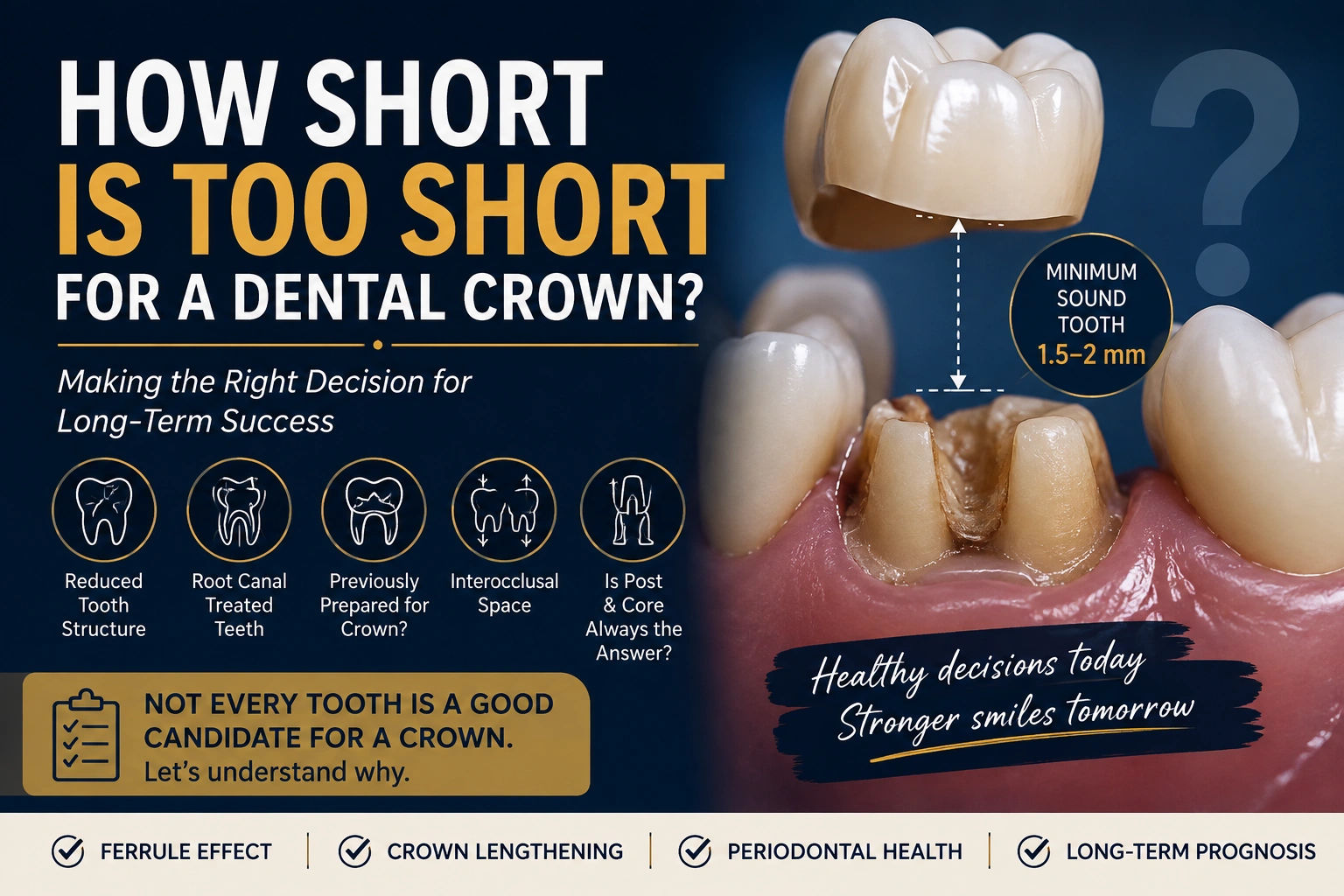
Research consistently shows that long-term success depends less on the post or crown material and far more on the amount of healthy dentin remaining above the gum line. A circumferential ferrule of approximately 1.5–2 mm of sound dentin significantly improves fracture resistance and clinical survival.
Notice the keyword:
Sound dentin.
Not composite.
Not core material.
Not cement.
Natural tooth.
Was the Tooth Already Prepared for a Crown?
This is an often-overlooked factor.
Sometimes a patient arrives with an old teeth crown that has fallen off.
The natural assumption is: "Doctor, the old cap fitted perfectly. Please cement a new one."
But what has happened over the years?
- The tooth has undergone root canal treatment.
- More decay may have developed.
- Previous crown preparation has already removed valuable tooth structure.
- Existing margins may extend deeper under the gums.
Every replacement crown usually means another layer of healthy tooth is sacrificed.
Eventually, there comes a point where there simply isn't enough tooth left to hold another dental crown predictably.
Is There Enough Space for a Dental Crown?
Even if enough teeth remain, another question arises:
Can we physically fit a crown?
A crown requires adequate thickness to withstand chewing forces.
If the opposing tooth has erupted into the space or there is minimal interocclusal clearance, additional reduction becomes necessary.
But here's the dilemma:
Reducing an already weakened tooth further may remove the very dentin that is needed to retain the dental crown.
Sometimes creating space for the crown actually makes the tooth less restorable.
Is a Post and Core Always the Solution?
One of the biggest myths in dentistry is: "Just put a post inside. That will strengthen the tooth."
Actually, posts do not strengthen teeth.
Their primary purpose is simply to retain a core when insufficient coronal tooth structure remains.
In fact, preparing a post space removes additional root dentin and may increase stresses within the root if an adequate ferrule is absent. Clinical evidence shows that posts cannot compensate for missing natural dentin, and post placement alone does not improve long-term tooth survival.
The strongest part of a restored tooth is not the post.
It is the remaining natural tooth structure.
Can Crown Lengthening Save Every Tooth?
Crown lengthening is an excellent procedure when used for the right reasons.
By removing gum tissue and, when necessary, supporting bone, the dentist exposes additional tooth structure so a crown can grip healthy dentin.
However, crown lengthening has limits.
Excessive crown lengthening may:
- Worsen the crown-to-root ratio.
- Reduce periodontal support.
- Expose root surfaces.
- Create plaque-retentive areas.
- Increase sensitivity.
- Bring the furcation closer to the oral cavity in molars.
- Make future periodontal maintenance more difficult.
If too much bone has to be removed just to obtain ferrule, the tooth may ultimately become less stable rather than more stable. Crown lengthening is contraindicated when it would leave an unfavorable crown-root ratio, compromise adjacent tissues, or fail to create a predictable restorative foundation.
Sometimes, saving a tooth surgically today may actually shorten its lifespan tomorrow.
So... How Short Is Too Short?
There isn't a single measurement that answers this question.
Instead, dentists evaluate several factors together:
- Is there at least 1.5–2 mm of sound ferrule?
- How thick are the remaining tooth walls?
- Is there adequate interocclusal clearance?
- Has the tooth already been heavily prepared?
- Is the root canal treatment predictable?
- Is there sufficient periodontal support?
- Will crown lengthening create more problems than it solves?
- Can the patient realistically expect long-term success?
If several answers are "No," then placing a dental crown may become an exercise in optimism rather than evidence-based dentistry.
Sometimes the Best Dentistry Is Knowing When to Say "No"
As dentists, we genuinely want to save teeth.
But there is an important difference between saving a tooth and delaying its inevitable failure.
Occasionally, the most ethical treatment is to explain honestly: "I can make a crown, but I cannot promise you that it will last."
That conversation may disappoint a patient today.
But it prevents disappointment—and potentially catastrophic failure—tomorrow.
Final Thoughts
Modern dentistry gives us remarkable materials, digital scanners, CAD-CAM crowns, fiber posts, and advanced adhesives.
Yet none of these technologies can replace what nature originally provided.
Natural tooth structure remains the most valuable restorative material in dentistry.
Before asking "Can this tooth receive a crown?"
Perhaps the better question is:
"Does this tooth still have enough healthy tooth left to deserve one?"
For further queries, reach out to Dr. Mili Gupta for expert opinion.
- A-3, Natraj Nagar near Imli Phatak, Jaipur-302015
- +91 9945826926
- contact@amddentalclinic.com

Questions to Ask Before Starting Clear Aligners | Patient Guide
Discover the key questions to ask before starting clear aligners! Get expert tips from AMD Dental Clinic to ensure a confident smile journey. Read more now!

Safest Teeth Whitening Methods in Jaipur | AMD Dental Clinic
Explore the safest teeth whitening methods, from at-home trays to in-office bleaching. Get expert-guided Teeth Whitening Treatment at AMD Dental Clinic.
Can Dental Implants Get Cavities? | AMD Dental Clinic Jaipur
Do dental implants get cavities? Learn the truth, common risks, and expert tips to make your implants last longer. Visit AMD Dental Clinic, Jaipur.