
Pain Relief After Root Canal: What Is Normal and What Is Not?
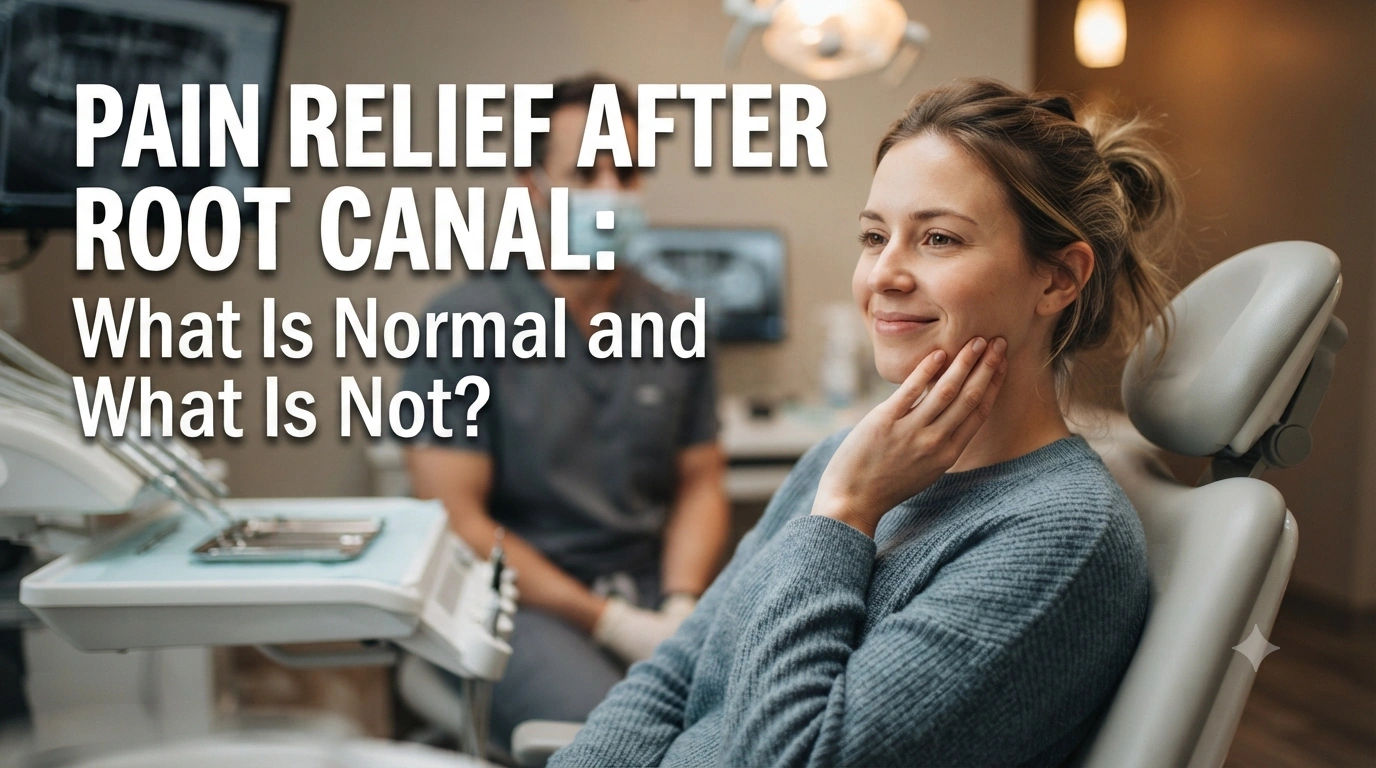
A root canal treatment is performed to remove infected or inflamed pulp from inside a tooth, clean and disinfect the root canals, and seal them so the tooth can be preserved. But one question patients often ask after treatment is:
“My root canal is done, so why does my tooth still hurt?”
Some discomfort after a root canal is completely normal. In fact, even after a well-performed single sitting RCT, the tissues around the root may remain mildly irritated for a few days.
However, not every type of tooth pain after root canal filling should simply be ignored.
Knowing what is normal, what needs a simple bite adjustment, and what may indicate a problem can help you recover comfortably and seek timely dental care when necessary.
At AMD Dental Clinic, Jaipur, we believe that root canal treatment is not just about completing the procedure. It is also about explaining what you should expect afterwards and being available if something does not feel right.
Is Pain After Root Canal Treatment Normal?
Yes, mild pain or tenderness after root canal treatment can be normal.
During RCT, the tooth and the tissues surrounding its root are cleaned and treated. Even though the infected nerve tissue inside the tooth has been removed, the periodontal tissues around the root can remain inflamed temporarily.
You may notice:
Mild soreness when biting or chewing
Tenderness around the treated tooth
A feeling that the tooth is slightly different from the surrounding teeth
Mild throbbing or discomfort during the first few days
Sensitivity of the surrounding gum, particularly if there was significant infection before treatment
Usually, this discomfort gradually improves rather than becoming progressively worse.
How long does discomfort last after RCT?
For many patients, noticeable soreness settles within a few days. If the tooth had a large infection, significant inflammation, or was painful before treatment, tenderness can sometimes persist for longer.
The important factor is the trend.
Improving pain is generally reassuring. Increasing or severe pain needs evaluation.
Every tooth and every infection is different, so recovery cannot be predicted by an exact number of hours or days.
What Does Normal Post-RCT Pain Feel Like?
Normal post-treatment discomfort is usually manageable.
For example, you may experience:
“It hurts slightly when I bite on it.”
or
“The tooth feels tender, but the pain is getting better each day.”
This type of soreness can occur because the tissues around the root were already inflamed before treatment. You may also experience mild discomfort if you accidentally chew hard food on the treated tooth soon after treatment. If the tooth has received only the root canal filling and still needs its final crown or restoration, your dentist may also recommend avoiding heavy chewing on that tooth until it has been properly restored.
When Is Tooth Pain After Root Canal Filling NOT Normal?
Pain deserves more attention when it is severe, persistent, worsening, or associated with swelling.
Contact your dentist if you experience:
Severe or throbbing pain that is getting worse
Significant swelling of the gum or face
Pus or a bad taste coming from the tooth
Fever or feeling generally unwell
Difficulty opening the mouth
Difficulty swallowing or breathing
Pain that initially improved but then suddenly becomes severe
A tooth that feels extremely high when you bite
Persistent significant pain that does not appear to be improving
These symptoms do not automatically mean that your root canal has failed. There can be several reasons for post-RCT pain, and the cause needs to be identified before deciding what treatment is required.
One of the Most Common Causes: A “High” Tooth
Sometimes the root canal itself is not the problem.
After treatment, a tooth can occasionally feel slightly higher than the surrounding teeth.
When you bite, that tooth may contact first and receive excessive pressure. This can irritate the periodontal ligament around the root and cause considerable tenderness.
Patients often describe it as: "The root canal tooth hurts whenever I bite.”
In such cases, your dentist may check your bite using articulating paper. If the treated tooth is indeed taking excessive contact, a small occlusal adjustment may provide significant relief.
This is why persistent biting pain should not automatically be assumed to mean that the RCT was unsuccessful. A simple bite problem can sometimes be the actual cause.
What If There Is Swelling After RCT?
Swelling deserves attention.
A small amount of local tenderness can occur, but new or increasing swelling should be reported to your dentist.
Your dentist may need to determine whether the swelling is related to:
Persistent infection
A flare-up of an existing infection
Drainage issues
A missed or untreated canal
A crack or fracture
An infection from another source
Importantly, antibiotics are not automatically required for every tooth that hurts after RCT.
The appropriate treatment depends on the clinical findings. Your dentist may need to examine the tooth, check the bite, take an X-ray, or recommend a CBCT in selected complicated cases.
What Can You Do for Pain After Root Canal?
If your dentist has confirmed that the tooth is healing normally, a few simple measures can make recovery more comfortable.
1. Avoid chewing hard foods on the treated tooth
Especially if the final crown or permanent restoration has not yet been placed.
A root canal-treated tooth may require definitive restoration to protect it from fracture.
2. Follow your dentist's medication instructions
If pain medication has been prescribed or recommended for you, take it according to your dentist's instructions.
Do not take multiple painkillers or antibiotics on your own simply because the tooth is sore.
3. Maintain oral hygiene
Continue brushing and cleaning your teeth normally unless your dentist has given you specific instructions otherwise.
Keeping the area clean is important for overall oral health.
4. Observe the direction of the pain
Ask yourself: Is it improving, staying the same, or getting worse?
A mild soreness that is gradually improving is generally less concerning than pain that becomes increasingly severe.
What Is a “Painless RCT”?
You may have seen advertisements promising a “100% painless RCT.”
Modern dentistry can make root canal treatment extremely comfortable for most patients through effective local anesthesia, careful technique, appropriate instruments, and good patient communication.
At AMD Dental Clinic, we aim for a comfortable and anxiety-friendly root canal experience.
However, it is important to be honest with patients:
Painless RCT does not necessarily mean zero discomfort before, during, or after treatment.
A severely infected tooth can sometimes be difficult to anesthetize completely. In addition, the tissues around the tooth may remain sore after treatment.
The goal should not be to make unrealistic promises. The goal should be to provide appropriate anesthesia, careful treatment, minimal unnecessary trauma, and clear guidance about recovery.
That is what we believe ethical dentistry should look like.
Is Single Sitting RCT Better?
A single sitting RCT can be an excellent treatment option when the tooth and clinical situation are suitable.
With modern rotary instrumentation, magnification where required, irrigation protocols, and effective obturation techniques, many routine root canal treatments can be completed in one appointment.
However, every tooth does not necessarily need to be treated in a single sitting.
The number of appointments depends on factors such as:
The presence and severity of infection
Anatomy and number of canals
Retreatment cases
Drainage requirements
Calcified or difficult canals
Patient symptoms
The dentist's clinical assessment
The priority should always be proper cleaning, disinfection, sealing, and preservation of the tooth, rather than simply completing the RCT as quickly as possible.
At AMD Dental Clinic, Jaipur, we recommend single-sitting RCT when it is clinically appropriate—not merely because it sounds attractive in an advertisement.
When Should You Return to Your Dentist?
If your pain is mild and steadily improving, you may simply need time for the tissues around the tooth to settle.
But do not wait if:
The pain is severe.
The swelling is increasing.
You cannot bite comfortably.
You develop fever.
You notice pus or a bad taste.
The tooth feels significantly higher than the others.
Your symptoms are getting worse instead of better.
Your dentist can determine whether you need a bite adjustment, medication, additional drainage, further imaging, or another form of treatment.
In complicated cases, an X-ray or CBCT scan may help identify problems that cannot be adequately assessed from a conventional dental X-ray alone.
A Good Root Canal Is More Than Just “Filling the Tooth”
One of the biggest misconceptions about RCT is that the procedure is simply about removing the nerve and filling the canals.
Successful root canal treatment involves several important steps:
Correct diagnosis → proper access → locating all canals → cleaning and shaping → effective disinfection → appropriate obturation → adequate coronal seal → timely final restoration → follow-up when required.
A technically completed filling does not automatically tell the whole story.
This is why choosing an experienced dentist and getting the tooth properly evaluated is important—especially when the tooth has unusual anatomy, previous RCT, persistent infection, or suspected fracture.
Why Patients Choose AMD Dental Clinic, Jaipur for Root Canal Treatment
At AMD Dental Clinic, Jaipur, our approach is based on careful diagnosis and patient-first dentistry.
We do not believe that every tooth should be treated according to a fixed formula.
Dr. Mili Gupta, MDS Prosthodontist & Implantologist, personally treats patients at the clinic, with a focus on conservative and ethical treatment planning.
Our clinic follows a systematic approach to root canal treatment, using technologies such as RVG and rotary endodontics where appropriate.
With extensive experience in RCT cases, our focus is not simply on completing the procedure but on understanding why the tooth needs treatment, whether it can be saved, and what restoration it will require afterwards.
We also believe patients should be told when a procedure is genuinely necessary—and when it is not.
That means no unnecessary treatment, no experimentation, and no unrealistic promises.
If you are searching for a dental clinic in Jaipur for root canal treatment, particularly if you have persistent pain after an RCT done elsewhere, getting a proper clinical evaluation is more important than simply choosing the clinic advertising the lowest price or the fastest treatment.
Frequently Asked Questions
1. How long should pain last after a root canal?
Mild soreness commonly settles over a few days, although teeth with significant pre-existing infection may take longer to become completely comfortable. The important sign is that the discomfort should generally be improving.
2. Why does my root canal tooth hurt when I bite?
A common reason is inflammation around the root or an excessive bite contact. If the tooth is hitting first, your dentist may be able to relieve the pressure with a minor bite adjustment.
3. Does pain mean my root canal has failed?
No. Pain alone does not prove RCT failure. The tooth needs clinical and, when necessary, radiographic evaluation to determine the cause.
4. Is single sitting RCT completely painless?
Modern anesthesia and techniques can make RCT very comfortable for most patients, but it is not appropriate to promise zero discomfort in every case. Some post-treatment soreness can be normal.
5. Should I take antibiotics for tooth pain after RCT?
Not necessarily. Antibiotics are not required for every case of post-RCT pain. Your dentist should determine whether there is an indication for them based on the clinical findings.
6. When should I see a dentist urgently?
Seek prompt dental care if you develop significant swelling, fever, severe worsening pain, pus, difficulty opening your mouth, or difficulty swallowing or breathing.
Looking for root canal treatment in Jaipur?
AMD Dental Clinic, Jaipur focuses on careful diagnosis, modern endodontic techniques, comfortable treatment, and honest treatment planning—because a successful dental treatment should begin with doing what is genuinely best for the patient.
- A-3, Natraj Nagar near Imli Phatak, Jaipur-302015
- +91 9945826926
- contact@amddentalclinic.com

How does bone density affect the timeline of a dental implant procedure?
Discover how bone density impacts dental implant timelines. Learn expert insights from Dr. Mili Gupta at AMD Dental Clinic. Read now for informed choices!
Why Do Your Gums Bleed While Brushing? Causes & Fixes
Bleeding gums while brushing? Get painless, expert treatment by Dr. Mili Gupta (MDS) at AMD Dental Clinic Jaipur. Book your appointment today!
What role does a Prosthodontist play in precision dental implant restoration?
Discover how a Prosthodontist ensures precision in dental implant restoration. Learn expert insights from Dr. Mili Gupta at AMD Dental Clinic. Read more!