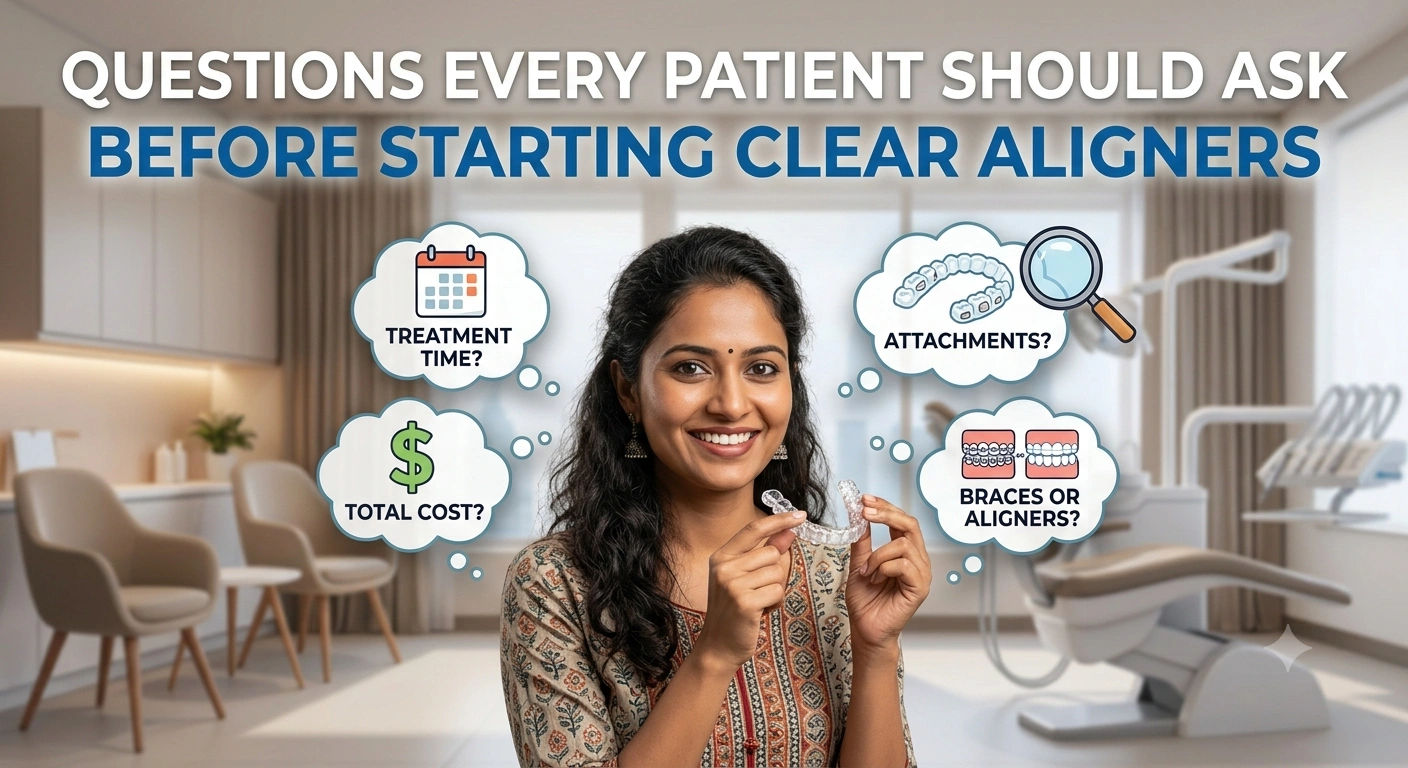
Questions Every Patient Should Ask Before Starting Clear Aligners
Don't Let Marketing Decide Your Smile
"Invisible." "Comfortable." "No braces." "Perfect smile in just a few months."
If you've been researching clear aligners, you've probably come across these promises. While clear aligners have transformed orthodontic treatment and can be an excellent option for many patients, they are not a one-size-fits-all solution. Like every dental treatment, they have advantages, limitations, and risks.
Unfortunately, many patients spend more time watching glossy animations than understanding what treatment actually involves.
As a patient, you deserve more than a sales pitch—you deserve complete information.
Here are 35 questions every patient should ask before saying "Yes" to clear aligners.
1. Am I really a good candidate for clear aligners?
Don't ask: "Can aligners fix my teeth?"
Instead ask: "Are aligners the BEST option for my case, or are braces likely to give a better result?"
Not every orthodontic problem responds equally well to aligners. A good orthodontist should explain why aligners are recommended—not simply that they can be used.
2. What are the limitations in MY case?
Every treatment has limitations.
Ask:
- Which tooth movements are predictable?
- Which movements are less predictable?
- What compromises might I have to accept?
If the answer sounds like "Everything will be perfect," ask more questions.
3. Can I see my complete treatment plan before I approve it?
The animated video looks impressive.
But remember...
An animation is not an explanation.
Ask your orthodontist to explain:
- every planned tooth movement
- where spaces will close
- whether your bite will change
- whether any compromises are expected
4. Who is actually planning my treatment?
This is one of the most overlooked questions.
Is your treatment planned by:
- your orthodontist?
- a company orthodontist?
- a technician?
- AI software?
- a planning team?
Understanding who is making the clinical decisions helps you understand who is responsible for those decisions.
5. Has my orthodontist personally reviewed every stage of my treatment?
Don't assume.
Ask directly.
A digital treatment plan should always be critically evaluated—not simply approved.
6. If something goes wrong, who is responsible?
Ask clearly:
- Is my orthodontist responsible?
- Is the aligner company responsible?
- Is the planning team responsible?
Patients should know who is accountable before treatment begins—not after problems arise.
7. What happens if my bite gets worse during treatment?
Teeth are not just meant to look straight.
They also need to bite together properly.
Ask: "If my bite changes in an undesirable way, how will it be corrected?"
8. Will ALL of my concerns be corrected?
If you have:
- spaces
- crowding
- deep bite
- overbite
- rotations
- crossbite
ask whether every issue is expected to improve.
Don't assume that because treatment is being offered, every concern will automatically be addressed.
9. Will any spaces intentionally remain?
Sometimes treatment plans intentionally leave spaces.
Ask to see them.
Never assume every gap will disappear.
10. Will I need IPR (Interproximal Reduction)?
If the answer is yes, ask:
- Why is it necessary?
- How much enamel will be removed?
- Are there alternatives?
- What are the risks?
- Can treatment proceed without it?
IPR may be appropriate in selected cases, but patients should understand why it is being recommended.
11. What if I decide against IPR?
How would the treatment plan change?
Would the result be different?
Would braces become a better option?
You deserve to understand your choices.
12. Are there any teeth that may not move as planned?
Not every tooth tracks perfectly.
Ask which movements are considered less predictable in your case.
13. How many refinements do patients like me usually require?
Refinements are additional aligners made after the initial series.
Ask for the average experience—not just the ideal scenario.
14. Is the quoted treatment time realistic?
If someone tells you: "Your treatment will finish in 20 weeks."
Follow it with: "Including refinements?"
The initial series is not always the end of treatment.
15. How many of your patients actually finish within the original timeline?
This question often tells you more than any brochure. Ask your orthodontist to patch you up with his patients who have completed the treatment.
16. How many refinement aligners are included in my fee?
Ask:
- Are refinements free?
- Is there a limit?
- Will I have to pay extra later?
Financial clarity prevents unpleasant surprises.
17. Will I need attachments?
Many patients are surprised to learn that aligners often require tooth-coloured attachments.
Ask:
- How many?
- Which teeth?
- How visible are they?
18. Can I see REAL photographs—not marketing images?
Request photographs of actual patients wearing aligners with attachments.
Realistic expectations lead to happier patients.
19. How visible are aligners during everyday life?
Ask about:
- attachments
- aligner edges
- speech
- smiling
- close conversations
"Invisible" doesn't necessarily mean "undetectable."
20. How difficult are they to remove?
Some patients remove them effortlessly.
Others struggle initially.
Ask:
- Will I need a removal tool?
- What should I expect during the first week?
21. Will my speech change?
Ask:
- Will I lisp?
- For how long?
- Do most patients adapt?
22. How uncomfortable is treatment?
Every patient experiences discomfort differently.
Ask what is normal—and what isn't.
23. What happens if my oral hygiene isn't excellent?
Aligners cover almost every tooth surface for most of the day.
Ask about:
- plaque build-up
- gum inflammation
- staining
- decalcification
- cavity risk
Good oral hygiene becomes even more important during treatment.
24. How much extra cleaning will I actually need?
Many patients underestimate this.
Ask:
- How often should I brush?
- Do I need to clean the aligners separately?
- What cleaning products are recommended?
25. Can I drink tea or coffee while wearing them?
If not,
how practical will removing and replacing them be during your daily routine?
Lifestyle matters.
26. What if I accidentally eat or drink while wearing them?
Knowing the consequences beforehand helps avoid unnecessary damage.
27. Will I need elastics or other accessories?
Some cases require:
- elastics
- bite ramps
- attachments
- buttons
Ask what additional components may be necessary.
28. How often will my orthodontist personally examine me?
Will your progress be monitored:
- face-to-face?
- remotely?
- mainly through photographs?
Regular clinical review remains important.
29. How will you know if my teeth are not tracking correctly?
Ask what signs are checked at each review.
Early detection often prevents bigger problems later.
Will there be scans during the treatment to gauge the progress or will it be a guess.
What will be the cost of repeat scan.
30. If I notice something isn't right, who do I contact?
Clarify whether your first point of contact is:
- your orthodontist
- a company representative
- customer support
- someone else
Knowing this beforehand can save valuable time.
31. If treatment doesn't go according to plan, who decides what happens next?
Is it:
- your orthodontist?
- the aligner company?
- another orthodontist?
Clinical decision-making should be transparent.
32. What happens if I'm unhappy with the final result?
Ask:
- What options are available?
- Will refinements help?
- Will there be additional costs?
- What is the process if expectations aren't met?
33. What happens if I decide to stop treatment halfway?
Understand:
- financial implications
- clinical consequences
- retention requirements
before treatment begins.
34. In cases like mine, how often do you recommend braces instead?
An orthodontist who occasionally recommends braces demonstrates that treatment recommendations are based on clinical needs—not just one product.
35. If this were your own son, daughter, spouse or sibling, would you recommend clear aligners for this exact case?
This simple question often leads to the most honest discussion of all.
Final Thoughts
Clear aligners have helped millions of people achieve healthier, more confident smiles, and for many patients they are an excellent treatment option. However, they are not automatically the best choice for every case, and they should never be selected based solely on marketing claims or convenience.
As a patient, you have the right to understand not only the benefits of treatment, but also its limitations, possible compromises, expected maintenance, treatment timeline, and who will be responsible for your care if things do not go exactly as planned.
Remember:
An informed patient is not a difficult patient. An informed patient is an empowered patient.
The best orthodontic treatment is not the one with the best advertisement. It is the one that is carefully planned, honestly explained, and individually tailored to your needs. If you still have some doubts, contact Dr. Mili Gupta. Or book an appointment at AMD Dental Clinic.
- A-3, Natraj Nagar near Imli Phatak, Jaipur-302015
- +91 9945826926
- contact@amddentalclinic.com

Safest Teeth Whitening Methods in Jaipur | AMD Dental Clinic
Explore the safest teeth whitening methods, from at-home trays to in-office bleaching. Get expert-guided Teeth Whitening Treatment at AMD Dental Clinic.
Can Dental Implants Get Cavities? | AMD Dental Clinic Jaipur
Do dental implants get cavities? Learn the truth, common risks, and expert tips to make your implants last longer. Visit AMD Dental Clinic, Jaipur.

Root Canal Treatment in Jaipur: A Painless, Honest Guide to Saving Your Natural Tooth
Suffering from tooth pain? Learn about painless single-sitting root canal treatment in Jaipur, costs, step-by-step procedure, and recovery from top MDS specialists.