
Root Canal Treatment in Jaipur: A Painless, Honest Guide to Saving Your Natural Tooth
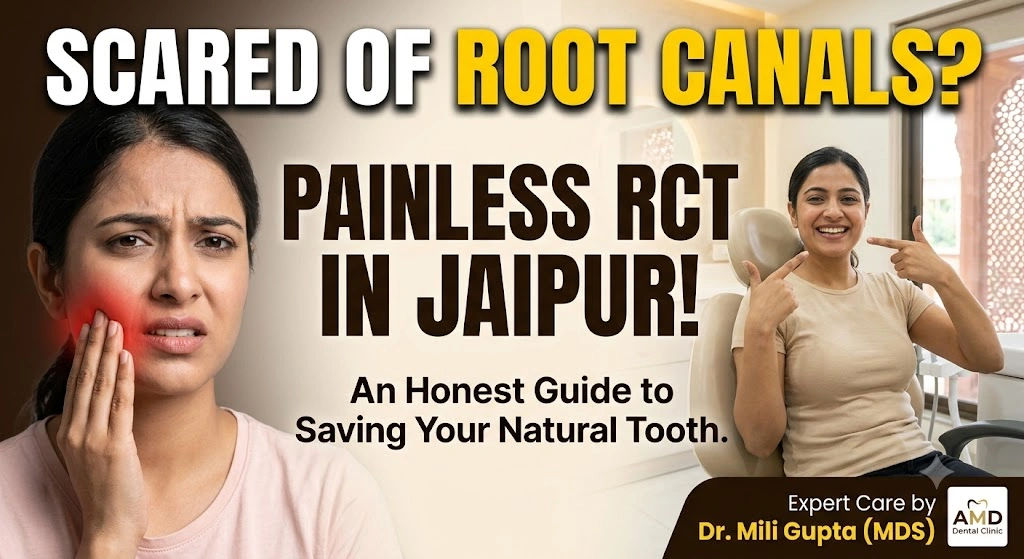
If you are waking up at night with severe toothache ("dant me tez dard"), feeling a sharp pain when drinking hot chai, or chewing on one side because a back tooth hurts, you are likely dealing with an infected tooth pulp.
The thought of getting a root canal treatment (RCT) makes many people nervous. The most common question patients ask when sitting in our clinic chair is: "Doctor, will this procedure hurt?"
The short answer is no. Modern root canal treatment does not cause pain—it relieves pain. With modern local anesthesia and rotary endodontics, getting an RCT today is as comfortable as getting a routine dental filling.
In this guide, we will break down everything you need to know about root canal treatment in Jaipur—how it works, what it costs, why saving your natural tooth is always better than pulling it out, and what to expect during recovery.
What is Root Canal Treatment (RCT)?
Every natural tooth has two main layers on the outside: enamel (hard white outer shell) and dentin (middle layer). Beneath these protective layers lies a hollow space called the pulp chamber, which houses sensitive nerves and blood vessels.
When bacteria penetrate deep into this pulp chamber due to deep decay (keeda lagna), cracks, or trauma, the tissue becomes inflamed and infected. Because the pulp is enclosed inside a hard tooth structure, swelling builds up intense pressure—causing that throbbing, unrelenting tooth pain.
A Root Canal Treatment (RCT) is a precision dental procedure designed to:
Gently remove the infected or dead pulp tissue from inside the tooth.
Thoroughly clean, disinfect, and shape the inner root canals.
Fill and seal the space with a sterile, biocompatible rubber material called gutta-percha.
Restore the tooth’s structural strength with a custom dental crown (Tooth cap).
Common Symptoms: How Do You Know You Need an RCT?
Not all toothaches require a root canal. Minor surface decay can be fixed with a simple composite dental filling. However, if bacteria have reached the inner nerve, you will likely experience one or more of these warning signs:
Persistent, Throbbing Pain: Severe pain that worsens when lying down or wakes you up in the middle of the night.
Lingering Sensitivity: Sharp pain when eating or drinking hot tea, soup, or cold water that lasts for seconds or minutes after the hot/cold source is removed.
Pain Upon Biting or Pressure: Inability to chew food on that specific tooth.
Swollen Gums (masoodon me sojan): A small pimple-like bump (abscess) on the gums near the painful tooth that may discharge pus or smell bad.
Tooth Discoloration: The tooth begins turning dark grayish or brownish due to internal tissue damage.
Referred Pain: Pain radiating to your jawline, ear, or temple on the same side of your face.
Note: Occasionally, an infected tooth pulp dies completely and stops sending pain signals to the brain. The pain might temporarily disappear, but the bacterial infection remains inside your jawbone and will slowly cause bone loss if left untreated.
What Causes Tooth Pulp Infection?
The inner pulp of your tooth is normally sterile and sealed tight. Infection occurs when that protective barrier is breached:
Deep Cavities (Keeda Lagna): When tooth decay is ignored for months, bacteria eat through the enamel and dentin until they reach the pulp chamber.
Cracked or Chipped Tooth: Hairline fractures from biting hard foods (like unpopped popcorn kernels or nuts) allow bacteria to seep directly into the nerve space.
Repeated Dental Procedures: Frequent restorations or large fillings on the same tooth over many years can irritate the nerve over time.
Physical Trauma: A sudden sports injury or accidental blow to the face can damage the blood supply to the tooth root, causing internal nerve tissue death even without visible external cracks.
How We Diagnose Your Tooth Pain
Accurate diagnosis is the cornerstone of ethical dentistry. We never guess when it comes to your health.
When a patient visits our clinic from nearby areas like Imli Phatak, Lal Kothi, or C Scheme complaining of tooth pain, we follow a systematic diagnostic process:
Digital RVG X-Rays (Radiovisiography): High-resolution digital imaging that uses 80% less radiation than conventional X-rays. This lets us see the exact depth of the cavity, the curvature of the root canals, and whether an infection has reached the surrounding jawbone.
Pulp Vitality Testing: Checking how the tooth nerve responds to gentle temperature changes.
Percussion & Periodontal Probing: Tapping the tooth lightly to evaluate if the surrounding ligament is inflamed.
If the decay is superficial and has not breached the pulp chamber, we will recommend a conservative dental filling rather than an RCT. We only recommend a root canal when saving the pulp is medically no longer possible.
Step-by-Step Procedure: What Happens During a Painless RCT?
Understanding the process removes fear. Here is what happens step-by-step during a modern root canal procedure:
Step 1: Complete Numbing (Zero Pain)
Before touched, the tooth and surrounding gums are completely numbed using targeted local anesthesia. You will feel a tiny pinch from the anesthetic gel, and within minutes, the entire area will be completely numb. You stay relaxed throughout the visit.
Step 2: Isolation & Access
A small protective rubber sheet (rubber dam) is placed around the tooth to keep it dry and completely free of saliva and bacteria during the procedure. A tiny opening is created on the top surface of the crown to reach the infected pulp chamber.
Step 3: Cleaning and Shaping (Rotary Endodontics)
Using ultra-flexible nickel-titanium (NiTi) rotary instruments and electronic apex locators, the infected nerve tissue is gently extracted from the microscopic canals. The inner walls are cleansed with antimicrobial irrigants to eradicate trapped bacteria.
Thanks to rotary technology, this step is fast, quiet, and highly precise.
Step 4: Canal Filling & Sealing (Obturation)
Once the canals are disinfected and dry, they are permanently sealed using gutta-percha—a natural, biocompatible material. This airtight seal prevents bacteria from ever re-entering the tooth root.
Step 5: Core Restoration & Dental Crown
A durable composite filling seals the top access hole. Because a root canal-treated tooth no longer receives a blood supply, it becomes somewhat brittle over time under heavy chewing forces. A custom-fitted dental crown (tooth cap)—such as Zirconia or Ceramic—is recommended to protect the tooth from fracture and restore full biting strength.
Single-Sitting vs. Multi-Sitting RCT: Which is Right for You?
With modern endodontic equipment, many root canals can be finished comfortably in just one sitting of 45–60 minutes. However, the decision depends entirely on the clinical state of your tooth.
| Parameter | Single-Sitting RCT | Multi-Sitting RCT |
| Ideal For | Fresh infection, non-complex canals, no pus or active swelling. | Severe infection, deep pus abscess, complex root anatomy. |
| Number of Visits | 1 Visit (45–60 mins) | 2 to 3 Visits ( spaced 3–7 days apart) |
| Procedure Goal | Complete cleaning, disinfection, and sealing in one visit. | Placing intra-canal calcium hydroxide medication to eliminate stubborn bacteria before sealing. |
| Convenience | Ideal for busy professionals, students, and travelers. | Necessary when maximum bone healing time is required. |
Benefits of Saving Your Natural Tooth vs. Extraction
When faced with toothache, some patients ask: "Doctor, why not just pull the tooth out (dant nikalwana)? Isn't that cheaper and faster?"
While removing a tooth might seem like an easy quick fix, extracting a natural tooth creates much bigger dental problems down the road:
Adjacent Tooth Shifting: When a gap is left empty, neighboring teeth slowly drift and tilt into the space, ruining your bite alignment.
Bone Loss: Without a tooth root stimulating the jawbone, the bone in that region slowly shrinks (resorbs) over time.
Higher Long-Term Cost: To replace a missing tooth later with a dental implant or bridge costs significantly more than saving the original tooth with an RCT.
Natural Chewing Efficiency: No artificial replacement fully duplicates the tactile sensation and natural feel of your real tooth root.
Golden Rule of Ethical Dentistry: Your natural tooth is always superior to any artificial replacement. Extraction should strictly be a last resort when the tooth structure is unsalvageable.
Recovery & Post-Treatment Care: What to Expect
Recovery after a root canal is smooth and simple. Here is how to ensure a comfortable healing process:
Manage Mild Tenderness: It is normal to feel mild soreness or jaw fatigue for 24 to 48 hours after local anesthesia wears off as tissue around the tooth settles. This is easily managed with prescribed anti-inflammatory medications.
Avoid Chewing on the Tooth Initially: Until your final permanent crown is placed, avoid chewing hard foods (like jawar, chana, or ice) on the treated tooth to prevent accidental cracking.
Maintain Oral Hygiene: Continue brushing twice daily and flossing gently around the treated tooth.
Soft Food Diet for Day 1: Stick to warm, soft foods like khichdi, dalia, curd, or paneer for the first day.
Understanding Root Canal Costs in Jaipur
Patients naturally want clear, transparent pricing. The cost of root canal treatment in Jaipur can vary based on several clinical factors rather than a "one-size-fits-all" number:
Key Factors Influencing RCT Cost:
Tooth Location: Front teeth (incisors and canines) have a single root canal, making treatment straightforward. Molars (back teeth) have 3 to 4 curved canals, requiring more specialized time and precision.
Technology Used: Rotary NiTi systems, apex locators, and digital RVG radiography yield higher success rates and faster treatment times.
Severity of Infection: Re-treatment of a previously failed RCT done elsewhere or treating teeth with deep calcified canals requires specialized endodontic techniques.
Choice of Dental Crown: Standard PFM (Porcelain-Fused-to-Metal) caps vs. high-strength Metal-Free Zirconia crowns.
At our clinic, we provide a complete, itemized diagnosis and treatment plan prior to starting any procedure—ensuring total transparency with zero unexpected costs.
Common Myths vs. Facts
Myth 1: "Root canal treatment causes severe pain."
Fact: RCT relieves severe pain caused by infection. Modern anesthetics keep you completely comfortable during the entire treatment.
Myth 2: "Getting the tooth pulled is better than getting an RCT."
Fact: Keeping your natural tooth preserves jawbone density and chewing alignment. Replacing a pulled tooth with an implant or bridge is far more expensive and time-consuming in the long run.
Myth 3: "A root canal kills the tooth completely."
Fact: The procedure removes internal nerve pulp, but the tooth remains nourished by surrounding periodontal ligaments and bone—allowing it to function normally for a lifetime.
Myth 4: "I don't need a crown after a root canal if the tooth doesn't hurt."
Fact: Without a crown, a root canal-treated tooth becomes brittle under normal biting pressure and can crack in half, leading to unavoidable tooth loss.
When Should You See a Dentist Immediately?
Do not ignore dental red flags. Schedule an urgent consultation if you experience:
Unbearable, throbbing toothache that over-the-counter painkillers cannot relieve.
Visible swelling in your gums, cheek, or neck area.
A cracked or broken tooth exposed after biting something hard.
A feeling that a specific tooth feels "taller" than the others when closing your jaw.
Key Takeaways
A root canal treatment removes infected pulp tissue, cleans the canals, and saves your natural tooth from extraction.
With modern rotary endodontics and local anesthesia, treatment is virtually pain-free.
Single-sitting RCTs are ideal for uncomplicated infections, while multi-sitting visits treat complex infections.
Always protect your root canal-treated tooth with a proper dental crown to ensure long-term durability.
Saving your real tooth is healthier and far more cost-effective than replacing a pulled tooth with a bridge or dental implant later.
Why Patients in Jaipur Choose AMD Dental Clinic
Located centrally at Natraj Nagar near Imli Phatak, AMD Dental Clinic serves patients across Jaipur including Bapu Nagar, Lal Kothi, C Scheme, Gopalpura, Civil Lines, and Mahesh Nagar.
Here is why families trust us with their oral health:
100% MDS Specialist Care: Every root canal and clinical procedure is personally evaluated and performed by Dr. Mili Gupta (MDS Prosthodontist & Implantologist). We do not hand off your treatment to junior or non-specialist staff.
Unmatched Clinical Experience: Over 30,000 successful Root Canal Treatments and 500+ Dental Implants performed with predictable, long-term outcomes.
Honest, Conservative Treatment Planning: We follow a strict medical ethic: we only recommend treatments that are genuinely necessary. If a tooth can be saved with a basic filling, we will never suggest an RCT.
Advanced Equipment: Equipped with digital RVG X-rays, precise rotary endodontics, apex locators, and piezosurgery tools to ensure painless, rapid healing.
Patient Education First: We take the time to explain your X-rays and options clearly so you make informed decisions about your health without high-pressure sales pitches.
Take the First Step Toward Pain-Free Dental Care
You don't have to suffer through tooth pain or fear dental treatments. Let us help you save your natural tooth comfortably and ethically.
Clinic Address: AMD Dental Clinic, A-3 Natraj Nagar, Near Imli Phatak, Jaipur, Rajasthan 302015.
Doctor: Dr. Mili Gupta (MDS Prosthodontist & Implantologist)
Nearby Landmarks: Easily accessible from Tonk Road, Lal Kothi, Bapu Nagar, Barkat Nagar, Mahesh Nagar, and C Scheme.
Action: Call or visit us today to get an honest diagnosis and immediate relief from tooth pain.
Frequently Asked Questions (FAQs)
Q1. How long does a root canal procedure take?
A single-sitting RCT usually takes 45 to 60 minutes. If your infection is severe and requires multiple visits, each appointment will take around 30 to 45 minutes.
Q2. Is a dental crown mandatory after an RCT?
In almost all back teeth (molars and premolars), a crown is necessary. Root canal treatment removes the inner blood supply, making the remaining tooth structure brittle over time. A custom cap seals and protects it against heavy chewing forces.
Q3. Will I need time off work after getting a root canal?
Usually, no. Most patients return to work or daily routines immediately after their appointment. You may experience slight tenderness once the numbness wears off, but this is easily managed with mild medication.
Q4. What happens if I delay getting a root canal?
Delaying treatment gives bacteria time to multiply deeper into the jawbone, leading to painful abscesses, swelling, bone loss, and eventually irreversible tooth loss requiring teeth extraction.
Q5. What is the success rate of root canal treatment?
When performed by an experienced specialist using modern rotary tools and proper sealing, root canal treatments have a high success rate exceeding 95% and can last a lifetime with proper oral hygiene.
Q6. Can a previously treated root canal tooth get infected again?
While rare, a root canal can fail if deep hidden canals were left uncleaned, if the crown leaks bacteria, or if new decay develops around the edges of the cap. In such cases, an endodontic re-treatment can clean and re-seal the root canals successfully.
Q7. Can I eat immediately after a root canal?
You should wait until the numbness from local anesthesia wears off (usually 2–3 hours) to avoid accidentally biting your tongue or cheek.
Q8. What is the cost of root canal treatment in Jaipur?
In Jaipur, root canal treatment typically ranges between ₹2,500 and ₹13,500 depending on the tooth location (front vs molar), infection severity, and whether single-sitting rotary technology is used.
- A-3, Natraj Nagar near Imli Phatak, Jaipur-302015
- +91 9945826926
- contact@amddentalclinic.com
Pain Relief After Root Canal: What Is Normal and What Is Not?
Discover what to expect after a root canal, including normal pain vs. warning signs. Read Dr. Mili Gupta's expert tips at AMD Dental Clinic for relief!

How does bone density affect the timeline of a dental implant procedure?
Discover how bone density impacts dental implant timelines. Learn expert insights from Dr. Mili Gupta at AMD Dental Clinic. Read now for informed choices!
Why Do Your Gums Bleed While Brushing? Causes & Fixes
Bleeding gums while brushing? Get painless, expert treatment by Dr. Mili Gupta (MDS) at AMD Dental Clinic Jaipur. Book your appointment today!