Thinking About Clear Aligners? The Truth About Refinements Every Patient Should Know
What Every Clear Aligner Patient Should Know Before Starting Clear Aligner Treatment
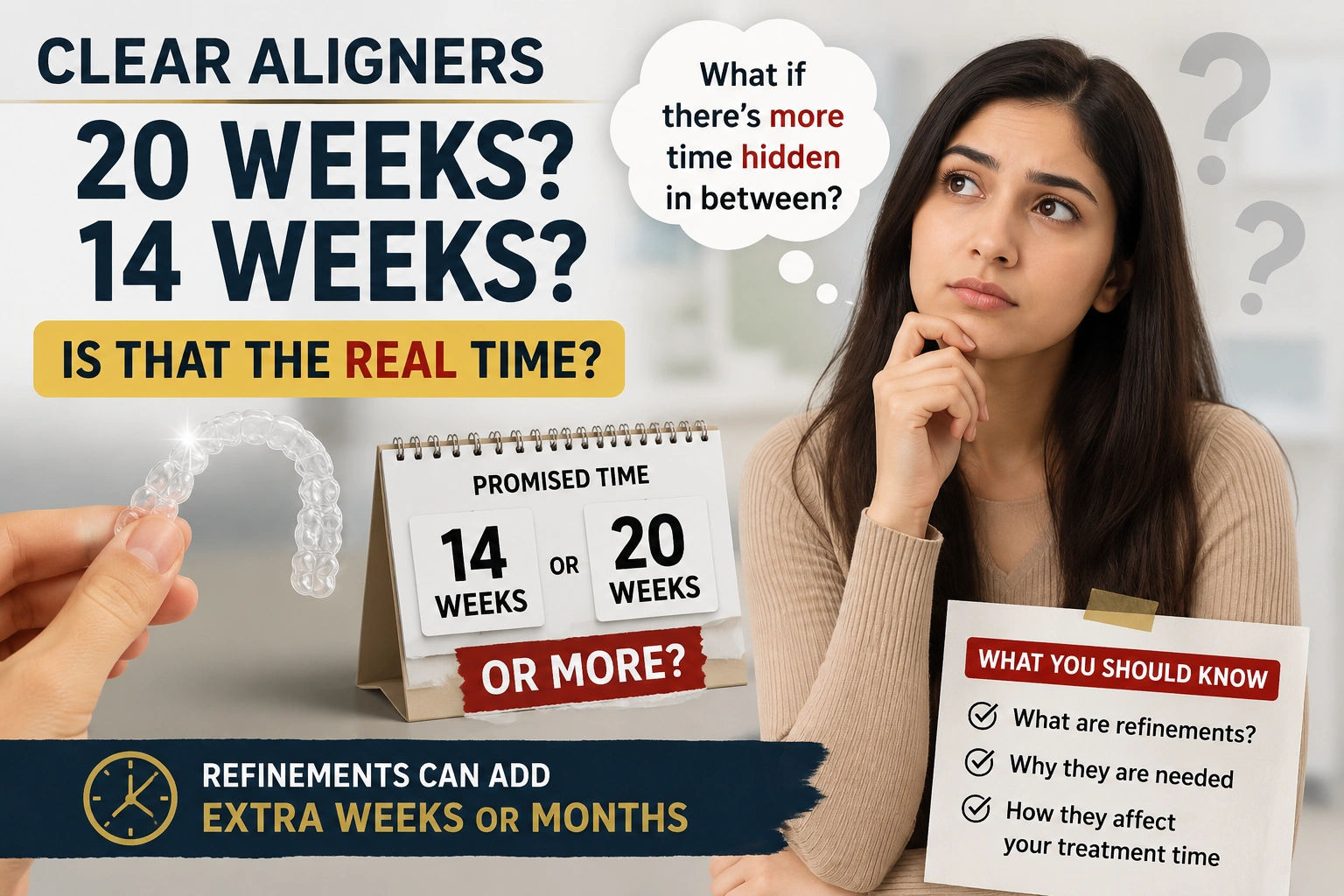
"Your treatment will take about 20 weeks."
If you're considering clear aligners, you've probably heard a timeline like this. It sounds reassuring, especially if you've been told that aligners are faster and more convenient than braces.
But here's a question many patients don't think to ask: "Is that the total treatment time, or just the first set of aligners?"
For many patients, the answer can make a huge difference.
Let's understand what refinements are, why they are so common, and why you should know about them before you start treatment.
The Promise That Attracts Everyone
Clear aligner advertisements often focus on three things:
"Invisible braces."
"Comfortable treatment."
"Straight teeth in just a few months."
Who wouldn't be interested? After all, everyone wants a beautiful smile with minimal inconvenience. The problem is not that these statements are always wrong. The problem is that they don't tell the whole story.
One of the most important parts of aligner treatment—refinements—is often discussed only after patients have already started treatment.
What Are Refinements?
Think of your initial aligners as Plan A.
They are designed based on a digital prediction of how your teeth are expected to move.
But teeth aren't robots.
Some teeth move exactly as planned.
Some move slower.
Some move differently.
Some may not move enough at all.
If your teeth don't match the digital plan after you've worn all your aligners, your orthodontist will usually take new scans or impressions and order another set of aligners. This second (or third) series is called a refinement.
Refinements are not unusual. In fact, they are a recognized part of clear aligner treatment for many patients.
Does That Mean Aligners Don't Work?
Not at all.
Clear aligners have transformed orthodontics and can produce excellent results in appropriately selected cases. However, they are not magic, and they are not perfect for every patient or every tooth movement.
A refinement doesn't automatically mean someone made a mistake. However, patients deserve to know upfront that refinements may be part of their treatment journey rather than assuming the first set of aligners will always be enough.
Biology is unpredictable. Computers can plan tooth movement, but they cannot guarantee exactly how every individual's teeth will respond.
So Why Aren't Refinements Always Discussed During the First Consultation?
There can be several reasons.
Sometimes the orthodontist genuinely believes the first series will achieve the planned result.
Sometimes refinements are mentioned briefly but patients don't realize how much they can extend treatment.
And sometimes the consultation focuses more on the ideal treatment plan than on the possibility of additional stages.
Whatever the reason, patients benefit from having an open discussion about both the best-case and the more likely scenarios before committing to treatment.
The Timeline That Patients See
Many advertisements say things like:
- "Straight teeth in 14 weeks."
- "New smile in 20 weeks."
- "Fast orthodontic treatment."
These timelines often refer to the initial aligner series.
If refinements become necessary, treatment may continue well beyond the original estimate.
That doesn't mean the original timeline was intentionally misleading, but it does mean patients should ask exactly what that timeline includes.
Why Do Teeth Need Refinements?
There isn't just one reason.
Common reasons include:
- Some teeth don't move as predicted.
- Rotated teeth can be more difficult to correct.
- Bite relationships may need additional adjustment.
- Small spaces may remain.
- Teeth may not fit together ideally after alignment.
- A patient's goals may change during treatment.
In many cases, refinements are simply part of achieving a better final result.
Why This Matters to Patients
Imagine planning your life around a six-month treatment.
You schedule weddings.
Professional photographs.
Job interviews.
Public speaking.
Travel.
Then you're told, "We'll need another 12 aligners." Suddenly, treatment continues for several more months.
Most patients aren't upset because refinements exist.
They're upset because they didn't know this was a possibility from the beginning.
Good communication helps patients set realistic expectations.
Questions You Should Ask Before Starting
Instead of asking only, "How long will treatment take?"
Try asking these questions:
- Is this timeline only for the first set of aligners?
- How often do patients with cases similar to mine need refinements?
- On average, how much longer do refinements add?
- Are refinement aligners included in the treatment fee?
- Is there a limit to the number of refinements covered?
- At what point would you recommend switching to braces if the planned tooth movements aren't being achieved?
These questions don't mean you're expecting problems—they simply help you understand the full treatment journey.
At Our Clinic, We Believe Patients Should Never Be Surprised
When someone visits our clinic in Jaipur for orthodontic treatment, our goal isn't simply to recommend one appliance over another.
Our goal is to help you choose the treatment that is most appropriate for your smile, your bite, your lifestyle, and your long-term dental health.
Whether that treatment is:
conventional braces,
ceramic braces,
self-ligating braces,
or clear aligners,
the recommendation should be based on your clinical needs—not marketing trends.
Before starting treatment, we take time to discuss:
whether aligners or braces are better suited for your case,
the expected treatment timeline,
the possibility of refinements if aligners are chosen,
any limitations or compromises,
and the realistic outcome you can expect.
Because informed patients make better decisions.
Why Many Patients Still Choose Braces
Many people are surprised to learn that, in certain situations, braces remain the more predictable option.
Depending on your bite and tooth movements, braces may offer advantages such as:
Better control of complex tooth movements.
Greater predictability in difficult bite corrections.
No need to remove the appliance before eating.
No concern about forgetting to wear them for 22 hours a day.
No repeated cycle of removing and reinserting aligners throughout the day.
This doesn't mean braces are "better" than aligners for everyone.
It simply means the right treatment depends on the right diagnosis.
What Should an Honest Consultation Include?
A good consultation should explain:
✔ The expected treatment time.
✔ The possibility that refinements may be needed.
✔ Why refinements happen.
✔ Whether they are included in the quoted fee.
✔ What happens if treatment takes longer than expected.
When patients understand these points before they begin, they are far less likely to feel disappointed if refinements become necessary.
Our Promise to Every Patient
We will never recommend braces just because they are traditional.
We will never recommend aligners just because they are fashionable.
Instead, we will recommend what gives you the safest, healthiest, and most predictable result.
Sometimes that will be aligners.
Sometimes that will be braces.
And sometimes, the most honest answer is that you have more than one good option.
Before You Say Yes to Any Orthodontic Treatment...
Ask questions.
Understand the process.
Know the limitations.
And don't be afraid to seek a second opinion if something doesn't feel clear.
A beautiful smile is an investment that lasts for years. It deserves careful planning—not just attractive advertising.
Looking for Honest Orthodontic Advice in Jaipur?
If you're confused about whether clear aligners or braces are right for you, we'd be happy to help.
At A.M.D. Dental Clinic, Jaipur, every orthodontic consultation begins with a detailed clinical examination and an open discussion about your options. You'll understand the benefits, limitations, expected treatment time, and costs before making a decision—so you can choose with confidence, not confusion.
Because the best smile starts with the right information.
- A-3, Natraj Nagar near Imli Phatak, Jaipur-302015
- +91 9945826926
- contact@amddentalclinic.com

Everyday Habits That Make or Break Your Teeth
Discover how common habits like "daant ghisna" impact your dental health. Learn tips to protect your smile from AMD Dental Clinic. Read now for healthy teeth!

We Only Remember Our Teeth When They Hurt
Discover why proactive dental care matters! Dr. Mili Gupta of AMD Dental Clinic shares insights to keep your teeth healthy & pain-free. Read now!

Bridal Smile Makeover Without Braces: What Are Your Options?
Discover bridal smile makeover options without braces! At AMD Dental Clinic, Dr. Mili Gupta shares tips for a radiant wedding-ready smile. Learn more today!