
What Makes an Implant Last 25+ Years
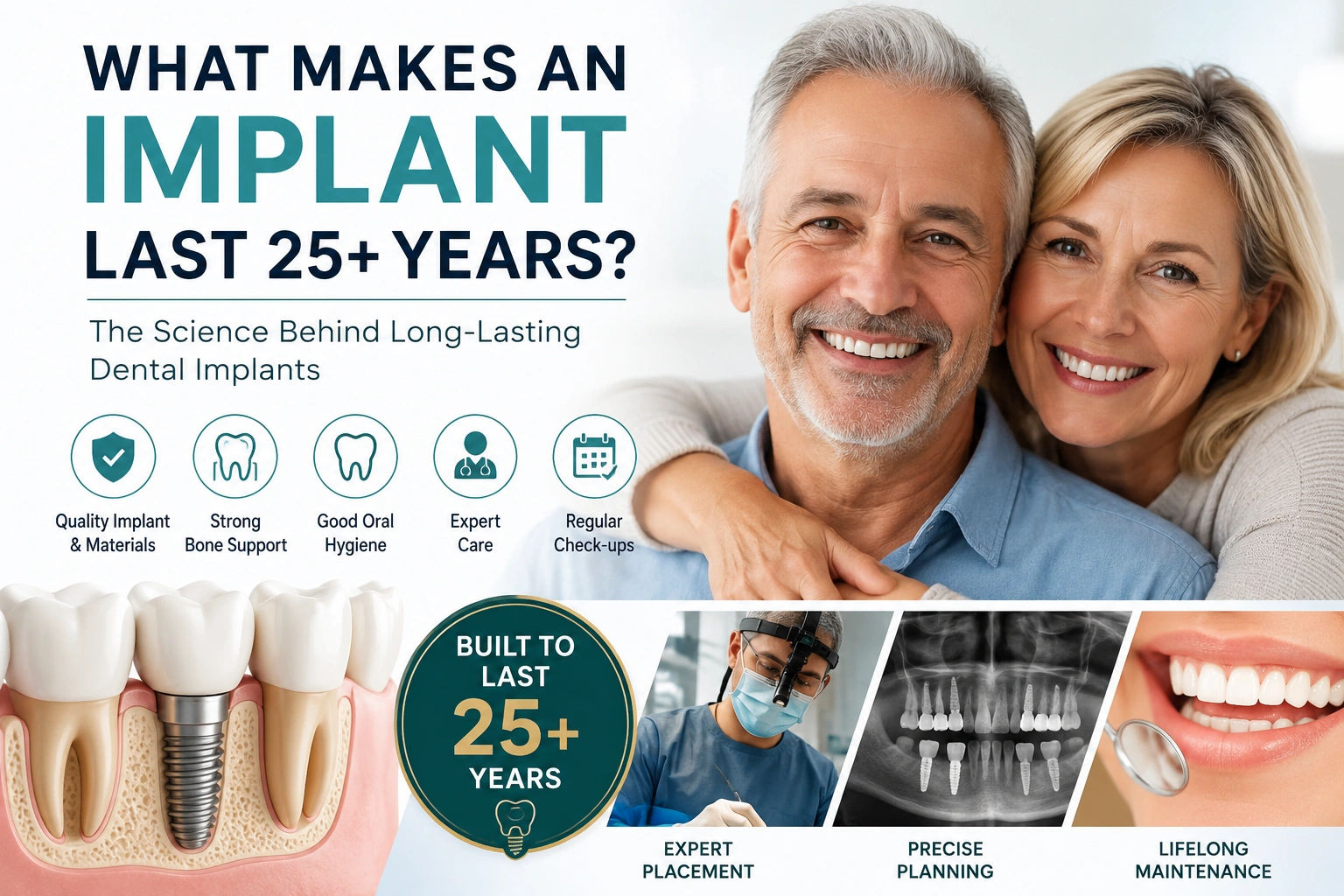
When patients ask us about dental implants, one of the most common questions is:
"Doctor, how long will my dental implant last?"
The answer often surprises them.
With proper planning, precise placement, and good oral care, a dental implant can last 25 years or even a lifetime. Numerous long-term clinical studies have shown survival rates above 90–95% even after two decades.
However, not every implant achieves this longevity.
Some implants fail within months, while others continue functioning perfectly after 30 years.
So what makes the difference?
The answer isn't just the implant brand. It's a combination of expert diagnosis, surgical skill, bone quality, oral hygiene, lifestyle habits, and regular maintenance.
In this guide, we'll explain exactly what determines the lifespan of a dental implant and how you can maximize its success.
How Long Does a Dental Implant Really Last?
A dental implant consists of three parts:
- Titanium implant placed inside the jawbone
- Abutment connecting the dental implant to the crown
- Ceramic or zirconia crown that replaces the visible tooth
These components have different lifespans.
- Titanium implant: Often 25+ years or lifelong
- Abutment: Usually lasts decades
- Crown: Typically lasts 10–20 years depending on wear
In many cases, if the crown wears out after years of chewing, it can simply be replaced while the implant remains securely integrated within the bone.
1. Implant Planning Is More Important Than Implant Placement
Many people believe dental implant surgery is the most important step.
In reality, planning determines success.
Before placing an implant, an experienced implant dentist evaluates:
- Bone height
- Bone width
- Bone density
- Position of nearby nerves
- Maxillary sinus location
- Bite forces
- Adjacent teeth
- Gum thickness
- Overall medical health
This is why a CBCT (3D scan) has become the gold standard before implant surgery.
Unlike traditional X-rays, a CBCT allows precise measurement of available bone and helps avoid complications.
Proper planning ensures the dental implant is placed in the strongest possible bone with ideal angulation.
2. Bone Quality Plays a Huge Role
An implant is not held in place by cement.
Instead, it becomes firmly attached to the jawbone through a biological process called osseointegration.
Healthy bone grows directly around the titanium surface, creating a strong and stable connection.
Better bone quality means:
- Faster healing
- Greater stability
- Reduced risk of implant movement
- Better long-term success
If the bone is insufficient, procedures like bone grafting or sinus lift surgery may be recommended before implant placement.
Although these procedures increase treatment time, they often improve the implant's long-term prognosis.
3. Choosing the Correct Implant Size Matters
An implant should not simply fit into the available space.
It should be selected according to:
- Bone dimensions
- Tooth position
- Bite forces
- Esthetic requirements
- Adjacent anatomical structures
Using an implant that is too short or too narrow when unnecessary may increase stress during chewing.
On the other hand, unnecessarily large implants may compromise surrounding bone.
Experienced implantologists carefully balance these factors to select the ideal implant dimensions for every patient.
4. Surgical Precision Determines Long-Term Success
Dental implant surgery is much more than drilling a hole in the bone.
Proper surgery requires:
- Minimal trauma
- Adequate irrigation to prevent bone overheating
- Correct drilling sequence
- Controlled insertion torque
- Accurate angulation
- Primary stability
Even slight deviations in placement may create problems later, including:
- Food trapping
- Difficult cleaning
- Excessive crown forces
- Gum recession
- Bone loss
Precision today prevents complications years later.
5. High-Quality Implant Systems Matter
Patients often compare implant prices without understanding what they're paying for.
Premium implant systems invest heavily in:
- Research
- Surface technology
- Precision manufacturing
- Quality control
- Long-term clinical trials
Modern implant surfaces encourage faster bone attachment and stronger osseointegration.
Established implant manufacturers also maintain consistent quality standards and provide replacement components years later if required.
The implant should be viewed as a long-term investment rather than a temporary solution.
6. Gum Health Is Just as Important as Bone Health
Healthy gums protect the bone surrounding the implant.
Poor oral hygiene allows bacteria to accumulate around the implant, leading to inflammation known as peri-implant mucositis.
If untreated, this may progress to peri-implantitis, a condition where infection causes gradual bone loss around the implant.
This is one of the leading causes of late implant failure.
Fortunately, it is largely preventable.
7. Daily Oral Hygiene Makes a Huge Difference
Dental implants cannot develop cavities.
However, they can still fail because of gum disease.
Patients should:
- Brush twice daily
- Use interdental brushes
- Floss around implants
- Consider a water flosser if recommended
- Attend professional cleaning appointments
Good hygiene removes bacterial plaque before it damages surrounding tissues.
Just because an implant is artificial doesn't mean it doesn't require care.
8. Smoking Significantly Reduces Implant Lifespan
Smoking is among the strongest risk factors for implant complications.
Nicotine reduces blood supply to healing tissues.
Smoking also:
- Slows healing
- Increases infection risk
- Reduces bone formation
- Increases peri-implantitis
- Raises long-term failure rates
Patients who stop smoking before and after surgery generally experience much better outcomes.
9. Medical Conditions Must Be Well Controlled
Many patients worry that diabetes automatically rules out implants.
Fortunately, this isn't true.
Dental implants can be highly successful in diabetic patients when blood sugar is well controlled.
Other conditions that require careful planning include:
- Osteoporosis
- Certain medications affecting bone metabolism
- Autoimmune disorders
- Previous radiation therapy
- Heavy teeth grinding (bruxism)
A detailed medical history allows your implant dentist to modify the treatment plan appropriately.
10. Bite Forces Need to Be Balanced
Your implant should not receive excessive pressure.
Unlike natural teeth, implants lack the periodontal ligament that helps absorb shock.
An improperly designed bite may overload the implant over many years.
This is especially important for patients who:
- Grind their teeth
- Clench during sleep
- Have missing teeth on the opposite side
- Have an uneven bite
Night guards are often recommended for patients with bruxism to protect both implants and natural teeth.
11. Regular Follow-Up Visits Catch Problems Early
Many implant problems develop silently.
Patients often experience no pain during the early stages of bone loss.
Regular reviews allow your dentist to monitor:
- Gum health
- Bone levels
- Implant stability
- Bite changes
- Crown condition
Small issues detected early are much easier to treat than advanced implant disease.
Think of implant maintenance like servicing a car—preventive care helps avoid costly repairs later.
Common Reasons Dental Implants Fail
Although implant success rates are very high, failures can occur.
Common causes include:
- Poor oral hygiene
- Smoking
- Untreated gum disease
- Inadequate bone support
- Poor surgical technique
- Incorrect implant positioning
- Excessive biting forces
- Failure to attend maintenance appointments
Most of these factors are preventable with proper planning and patient cooperation.
Signs You Should Visit Your Implant Dentist
Contact your dentist if you notice:
- Bleeding around the implant
- Persistent bad breath
- Swollen gums
- Pus discharge
- Pain while chewing
- Implant mobility
- Food getting trapped repeatedly
- Gum recession exposing metal
Early treatment often prevents permanent damage.
Myths About Implant Longevity
Myth 1: Dental implants last forever without care.
Reality: Implants require lifelong maintenance and regular professional check-ups.
Myth 2: Expensive implants automatically last longer.
Reality: Even the best implant system can fail if planning, surgery, or oral hygiene is poor.
Myth 3: Older patients cannot get long-lasting implants.
Reality: Age alone is rarely a limiting factor. Overall health and bone quality matter much more.
Frequently Asked Questions
Can a dental implant really last for life?
Yes. Many patients enjoy implants for 25–30 years or longer with proper care, excellent oral hygiene, and regular dental reviews.
Will I need to replace the implant?
The titanium implant itself often remains stable for decades. The crown attached to it may require replacement after years of normal wear.
Does implant maintenance hurt?
No. Routine implant cleaning is usually comfortable and similar to a professional dental cleaning.
Is brushing enough?
Brushing is essential but may not clean all areas around an implant. Interdental brushes, floss, or other aids recommended by your dentist help maintain healthy gums.
Final Thoughts
A dental implant is one of the most predictable and long-lasting solutions for replacing missing teeth—but its longevity is never determined by the implant alone.
Successful implants result from careful diagnosis, meticulous surgical planning, high-quality materials, healthy bone, good oral hygiene, and regular follow-up care. When these factors come together, an implant can restore not only your smile but also your confidence, comfort, and chewing ability for decades.
Choosing an experienced implant dentist and staying committed to long-term maintenance are the two biggest investments you can make in ensuring your implant lasts 25 years or more.
If you're considering dental implants or want to know whether you're a suitable candidate, a comprehensive consultation with a CBCT evaluation can help create a treatment plan tailored to your needs and designed for lasting success.
- A-3, Natraj Nagar near Imli Phatak, Jaipur-302015
- +91 9945826926
- contact@amddentalclinic.com
Pain Relief After Root Canal: What Is Normal and What Is Not?
Discover what to expect after a root canal, including normal pain vs. warning signs. Read Dr. Mili Gupta's expert tips at AMD Dental Clinic for relief!

How does bone density affect the timeline of a dental implant procedure?
Discover how bone density impacts dental implant timelines. Learn expert insights from Dr. Mili Gupta at AMD Dental Clinic. Read now for informed choices!
Why Do Your Gums Bleed While Brushing? Causes & Fixes
Bleeding gums while brushing? Get painless, expert treatment by Dr. Mili Gupta (MDS) at AMD Dental Clinic Jaipur. Book your appointment today!