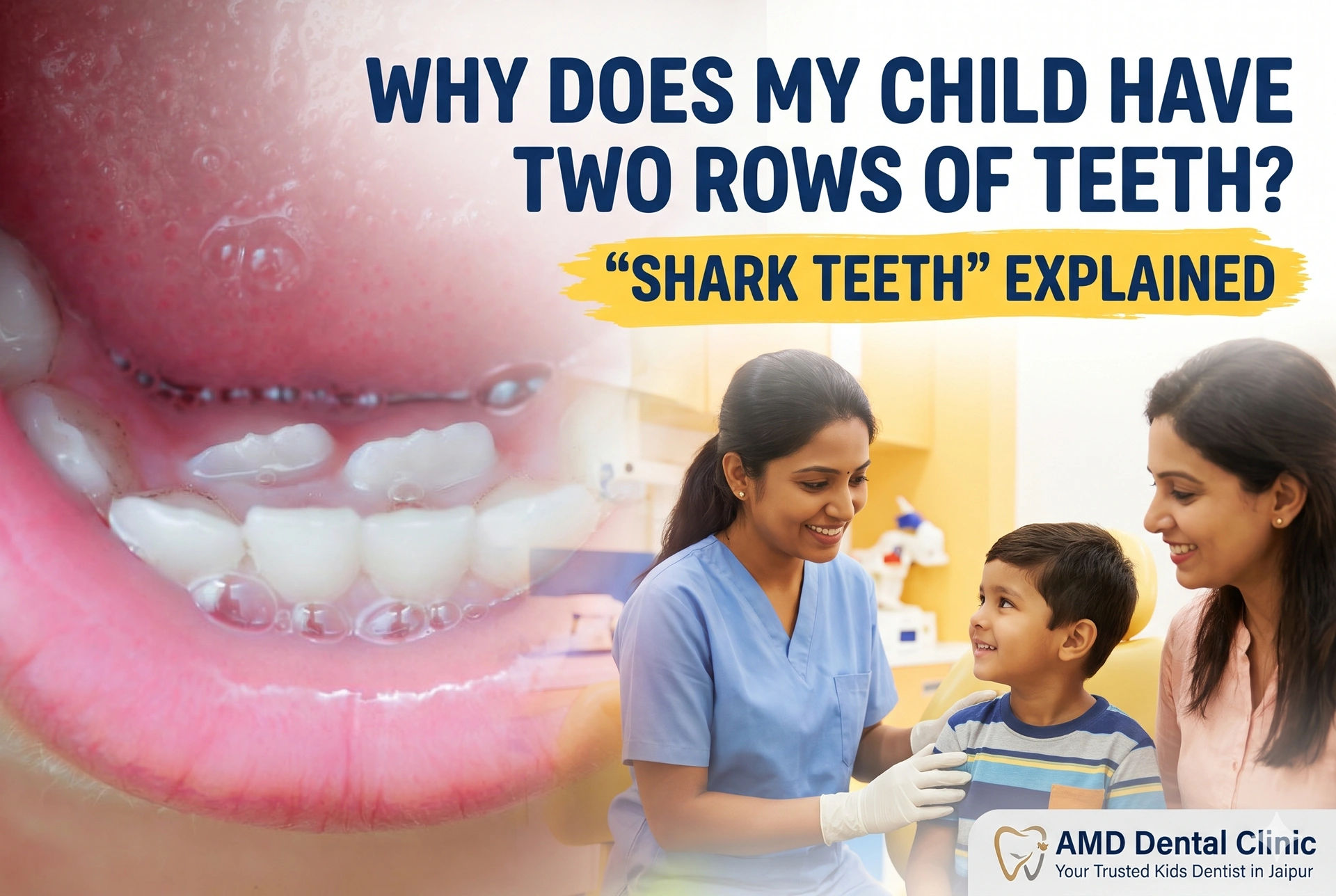
Nothing catches a parent off guard quite like asking your child to smile wide and spotting a brand-new tooth poking through behind a baby tooth that hasn’t even fallen out yet. For a moment, your child’s smile looks like it belongs to a great white shark.
Before you panic, take a deep breath. In dentistry, this is actually a very common developmental quirk colloquially known as "shark teeth" (or clinically as ectopic eruption). While it looks dramatic, it is usually harmless and straightforward to manage—especially when caught early by a trusted kids dentist in Jaipur.
Here is everything you need to know about why shark teeth happen, when to wait it out, and when it is time to schedule a dental visit.
What Exactly Are "Shark Teeth" in Kids?
Normally, as a permanent adult tooth grows upward through the jawbone, it pushes directly against the roots of the baby tooth sitting above it. This pressure causes the baby tooth's roots to dissolve—a process called resorption. Once the root is gone, the baby tooth becomes wiggly and falls out, leaving a neat, empty space for the adult tooth to move into.
Sometimes, however, the permanent tooth comes in slightly off-track, usually behind (on the tongue side of) the baby tooth. Because it misses the baby tooth’s roots, those roots never dissolve. The baby tooth stays firmly anchored in place while the permanent tooth erupts right behind it, creating a double row of teeth.
When Does This Usually Happen?
Shark teeth can occur at any point during the transition from baby teeth to permanent teeth, though there are two peak windows:
-
Around Age 6: This is the most common stage, typically affecting the lower front incisors. As the first adult bottom teeth come in, they frequently emerge behind the baby incisors.
-
Around Age 11: The second wave often happens when the upper back molars or premolars erupt, occasionally pushing through beside or behind stubborn baby molars.
Why Do Some Children Get Double Rows of Teeth?
There isn’t just one single cause, and it is rarely anything a parent did or didn't do. The most frequent triggers include:
-
Stubborn Baby Tooth Roots: If the permanent tooth bud is positioned slightly behind the baby tooth, it fails to trigger root resorption, leaving the baby tooth firmly rooted.
-
Crowding in the Jaw: If a child’s jaw is slightly narrow, there simply isn't enough room for larger permanent teeth to line up neatly beneath the smaller baby teeth, forcing the new teeth to take the path of least resistance.
-
Delayed Baby Tooth Loss: Some children naturally hold onto their primary teeth longer than average, even while their adult teeth are ready to emerge on schedule.
The "Wiggle Test": What Parents Can Do at Home
If you spot a second row of teeth, your first step is a gentle check at home. Have your child wash their hands and gently wiggle the front baby tooth.
-
If the baby tooth is noticeably loose: Encourage your child to wiggle it gently with their tongue or clean fingers every day. Crunchy, healthy foods like sliced apples, carrots, and cucumbers can also help coax the tooth out naturally. In most cases, once the baby tooth falls out, the tongue's natural forward pressure will push the permanent tooth right into its proper spot over the next few weeks.
-
If the baby tooth is rock-solid: Do not try to force or pull it out. If a baby tooth isn't moving at all, its roots are likely still completely intact, and forcing it can cause unnecessary pain, bleeding, or gum trauma.
When Should You Visit a Children Dentist in Jaipur?
While many cases resolve on their own, professional evaluation ensures your child’s bite develops properly without long-term crowding. You should book an appointment with a children dentist in Jaipur if:
-
The baby tooth isn’t loose at all even though the permanent tooth behind it has grown to nearly the same height.
-
Two weeks have passed since you first noticed the new tooth, and the baby tooth still shows zero signs of loosening.
-
Your child complains of pain, soreness, or bleeding around the double row of teeth, or has trouble brushing the tight space between the two rows (trapped food here can quickly lead to cavities or gum inflammation).
-
Multiple teeth are erupting behind baby teeth, which can be an early sign of significant dental crowding.
How a Dentist Treats Shark Teeth
At a conservative, child-friendly practice like AMD Dental Clinic, the goal is always the gentlest, least invasive approach. If a quick digital X-ray confirms that the baby tooth's roots haven't dissolved and are blocking the adult tooth, the dentist may recommend a simple, painless extraction of the stubborn baby tooth.
Once that barrier is removed, nature usually does the rest—the tongue gradually guides the permanent tooth forward into alignment, often preventing the need for complex orthodontic work later on.
Keeping Your Child’s Growing Smile Healthy
Double rows of teeth can be tricky to keep clean because food particles easily get wedged in the narrow gap between the front and back teeth. Until the baby tooth comes out, help your child angle their toothbrush gently along the gumline between both rows twice a day, and continue daily flossing.
If you’ve spotted shark teeth in your child’s smile and aren’t sure whether to wait it out or step in, a quick check-up with an experienced kids dentist in Jaipur at AMD Dental Clinic (near Imli Phatak) will give you clear answers and complete peace of mind.

About the clinic